If life exists beyond our world, would it look anything like us? This question becomes much more interesting when we stop thinking only about whether life exists and start asking what that life might actually look like.
Could creatures on another world have eyes, limbs, muscles, and a communication system like ours? Could their bodies change because of different gravity, temperatures, seasons, or sunlight? Or could there be forms of life so different from us that we would not even recognize them as living creatures?
To explore these possibilities, we first need to look at something that may be common between our world and other worlds: carbon.
Why Carbon Is So Important:
All known life on Earth is based on carbon. Carbon has a special ability that makes it different from many other elements. Its atoms can bond with other atoms in complex ways and form large molecules that can remain stable. This ability allows carbon to form an enormous variety of compounds.
Carbon is found in materials such as coal and diamonds, and it is also part of our own bodies. Because carbon is found throughout the universe, it is possible that life beyond Earth could also be carbon-based. If another world has conditions similar to Earth, its living creatures might therefore have some similarities to life here.
But that does not mean they would look exactly like us. Nature can produce very different forms depending on the environment.
What Would an Alien Creature Need?
Imagine a creature living on another world. Even if its body looked completely different from ours, it would still need certain abilities to survive. The first would be some way of sensing its environment. The source suggests that such a creature would need at least two eyes or two similar receptors that allow it to understand what is happening around it.
But the position of those eyes could also tell us something about the creature’s way of life. Humans have eyes facing forward, similar to many predators. A lion or tiger uses forward-facing eyes to judge distance and approach its prey.
Animals such as rabbits and deer usually have eyes positioned more toward the sides of their heads, giving them a wider view of their surroundings. This leads to an interesting possibility. If an alien creature were a hunter, its eyes might develop in a position that helped it judge distance and attack efficiently.
If it were usually prey, its sensory system might develop differently. The creature would also need some way to interact with its environment. That could be hands, claws, tentacles, or something completely different. Finally, it would need some form of communication.
Without communication, members of a species would have difficulty interacting, cooperating, or reproducing. So even a completely alien creature might still need systems for sensing, interacting, and communicating.
What If Its World Were Different?
Now imagine changing the environment. What if the planet’s days were longer? What if its seasons were more extreme? What if its gravity were stronger?
What if the shape of its surface were different? What if its star produced different kinds of light? Even small environmental differences could produce major changes in the creatures living there. Consider temperature first.
If a planet had very long days and therefore long periods of heat, its creatures might not need thick fur to keep themselves warm. But a world with extremely long nights and severe winters could produce creatures with much thicker bodies and more fur. Their physical appearance could therefore be a direct response to the conditions of their planet.
What Would Stronger Gravity Do?
Gravity could make an even bigger difference. If another world had stronger gravity than Earth, creatures living there would have to support greater weight. The theory suggests that such creatures could develop stronger bones and larger muscles. Their hearts could also need to become stronger to supply blood throughout larger and more powerful bodies.
Imagine a creature with a large body, a powerful chest, strong muscles, and the ability to survive under much greater gravitational force. It could look completely different from anything on Earth. Now imagine the opposite.
A World With Lower Gravity:
A world with much lower gravity could create an entirely different environment. According to the source, very low gravity could make it difficult for a planet to retain its atmosphere. If the atmosphere became too thin, the surface could become extremely difficult for life. Creatures might therefore live underground.
Deep caves could provide protection from the harsh conditions above. Because caves receive little light, creatures living there might develop very large eyes to collect as much available light as possible. We already know nocturnal animals on Earth that have adaptations for seeing in darkness.
But if such creatures eventually adapted to living on the surface, they might become tall and relatively thin. Plants and trees could also grow much taller under lower gravity. This means that even creatures based on the same basic chemistry as Earth life could look dramatically different simply because their planet was different.
A Different World, A Different Human Form:
The source then connects this idea with an Islamic account concerning Adam. According to the account presented in the transcript, Adam was created in another realm or world and later sent to this world. The source refers to reports describing Adam as having a height of sixty cubits in that other realm.
It also describes reports stating that the height of Adam’s descendants decreased after entering this world. The theory presented here interprets these differences through the idea that the original world had different natural conditions, including different effects of gravity.
In this interpretation, the physical characteristics of living beings could depend strongly on the world in which they exist. The source further refers to reports describing a future return to that other world and a restoration of the sixty-cubit height.
The creator presents these accounts as another example of how different worlds could have different physical conditions and therefore different forms of life.
The Second Hall: A Completely Different Kind of Life:
Until now, we have imagined creatures that are broadly similar to life on Earth. But what if life did not use carbon at all? This leads to the second hall of the creator’s imagined House of Creatures. The creatures in this hall would represent a completely different form of life.
They would not be based on the biology we know. Instead, the source introduces silicon.
Could Silicon Replace Carbon?
Carbon is extremely useful for creating complex molecules. But silicon has an interesting property as well. Its atoms can also form bonds with other atoms, and silicon is abundant throughout the universe. The source therefore proposes silicon-based life as one possible form of exotic life.
According to the theory, silicon-based organisms could potentially tolerate a much wider range of temperatures than ordinary carbon-based life. Such creatures might survive extremely cold conditions as well as extremely hot environments. They might not need fur to stay warm.
They could potentially live at high elevations or in environments where ordinary Earth life would struggle. The source also suggests that silicon-based organisms could be much lighter because silicon atoms do not form molecules in exactly the same way as carbon. This raises the possibility of creatures capable of flying or floating through their environment.
A Metallic Form of Life?
There is another unusual difference in this theory. Carbon-based life on Earth is generally associated with soft biological tissues. Silicon-based life, according to the source’s imagined model, could instead have a more metallic nature. The result could be a creature that looks shiny and completely unfamiliar.
It might not have skin like ours. It might not have flesh like an animal. It could be something that looks more like a living machine while still being a genuine organism. This is where the idea of exotic life becomes especially interesting.
The Idea of Multiple Worlds:
The possibility of other worlds is not presented as a new idea. The source introduces the concept of pluralism, meaning the possibility that more than one world exists. According to the transcript, ideas about multiple worlds have appeared in different cultures and religious traditions for thousands of years.
The source then turns to an important moment in the history of human thought. For centuries, many people in Europe believed that Earth occupied a special central position in the universe. Then came Giordano Bruno.
Giordano Bruno’s Extraordinary Vision:
Giordano Bruno was an Italian priest who imagined a universe in which Earth was not the center. According to the story presented by the creator, Bruno imagined Earth as one planet among many, moving around the Sun. He also imagined other worlds containing their own forms of life. At the time, these ideas were highly controversial.
The source describes Bruno as refusing to abandon his claims despite pressure from the Church. He was eventually imprisoned and later executed. Bruno was not a scientist and could not provide the kind of scientific evidence that would later support parts of his vision. But the story did not end there.
Galileo and the Other Worlds:
About a decade after Bruno’s death, Galileo Galilei used a telescope to observe the sky. His observations provided evidence that Earth was not the only world with objects moving around it. He observed four large moons orbiting Jupiter:
- Ganymede
- Callisto
- Europa
- Io
These became known as the Galilean moons. For the creator, this is an important historical lesson. An idea that once seemed impossible can later become supported by observation. Bruno’s vision of a universe containing other worlds therefore became much more interesting after telescopic astronomy began revealing the complexity of the universe.
But Bruno had imagined something even more extraordinary. He had imagined living creatures on those other worlds.
Could Fiction Become Reality?
The creator then makes a broader argument. Ideas that sound like science fiction today may eventually become scientific reality. Several examples from novels are introduced. In Technical Error, Arthur C. Clarke described an experiment that produced a mirror-like version of a person.
In The Doorways in the Sand, Roger Zelazny explored a machine that could alter cells and produce another version of a person. And in The Cibola Burn, James S. A. Corey described humans trying to grow food under the different environmental conditions of another planet. These are fictional ideas.
But the creator’s point is that fiction sometimes explores possibilities before science has the ability to test them.
The Idea of Mirror Life:
The discussion then moves from fiction toward biology. The source introduces Louis Pasteur and the concept of homochirality. The basic idea is that biological molecules can have different orientations, and life on Earth uses particular arrangements. The creator then explores what might happen if these orientations were reversed.
Could there be a form of life that looks similar to us but is effectively a molecular mirror image? This idea eventually connects with synthetic biology. The source describes scientists creating a new form of bacteria through extensive engineering. The larger point is not simply that humans can modify organisms.
It is the scale of possibility. If humans can begin creating unusual biological forms within a relatively short period, what might nature have produced during billions of years on other worlds?
What Could Be Waiting Beyond the Doors?
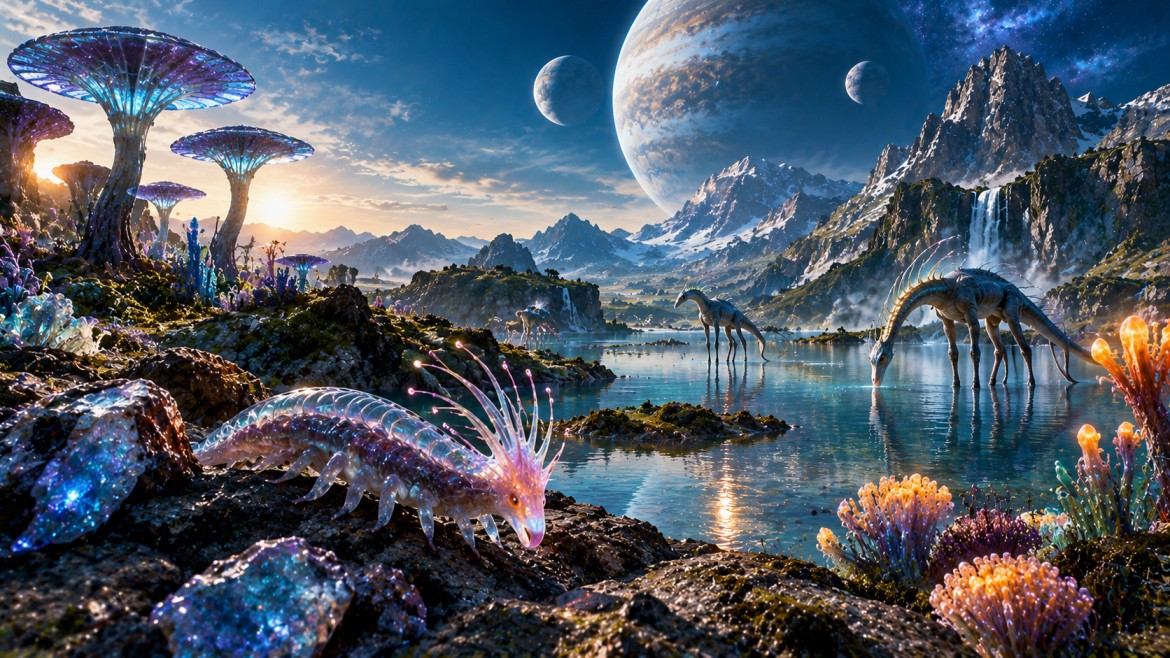
At this point, the second hall of the House of Creatures becomes much more mysterious. The first hall contained creatures that were variations of life as we know it. They could have different eyes, limbs, bodies, muscles, fur, or other adaptations depending on their environment. The second hall is different.
Here, life itself could be based on different chemistry. It could be silicon-based rather than carbon-based. It could have a metallic appearance. It could survive temperatures that Earth life could not tolerate.
It could exist under physical conditions completely unfamiliar to us. And it could potentially develop forms that humans would struggle even to recognize as life. This is the central question behind the entire journey: If the universe contains other worlds, why should we expect life on those worlds to look like us?
Perhaps some forms of life would be familiar. Perhaps others would be completely alien. And perhaps the greatest mystery is not whether such creatures exist, but how different life can become when nature is given a different world in which to work. The door to those possibilities remains open.