Across ancient civilizations, the Sun, Moon, stars, and the changing seasons were often treated as more than simple features of the sky. Some ancient cultures believed that certain days were special moments when the boundaries between different worlds could become thinner.
One of the most intriguing examples of this idea can be found in Mexico, at the ancient site of Teotihuacan. But what makes Teotihuacan especially interesting is not only its enormous pyramids. It is the strange connection between the Sun, the equinox, and a mysterious winged serpent.
Teotihuacan and the Three Great Temples:
Teotihuacan is a place in Mexico whose name is commonly understood as meaning a place where gods came down. The site contains three major pyramids or temple structures. The first is known as the Temple of the Sun. The second is the Temple of the Moon. But the third has a very different name:
The Temple of the Winged Serpent.
This difference immediately raises an interesting question.
Why were two structures named after the Sun and Moon, while the third was associated with a winged serpent?
And what did this winged serpent represent?
According to the theory explored in this article, the answer may be connected to ancient beliefs about the sky, special astronomical dates, and doors between different worlds.
A Ritual Still Performed Today:
The connection between these ancient ideas and astronomical dates is not limited to the distant past. Every year around the March equinox, large numbers of people gather at the Temple of the Sun. During the ritual, people wear white and red clothing, face the Sun, raise their hands toward the sky, burn incense, and climb the hundreds of steps toward the top of the pyramid.
The people taking part in the ritual explain that they are following the path and wisdom of their ancestors.
They believe that the March equinox was once a special moment when they were in a particular position within the universe. According to their interpretation, climbing the Temple of the Sun brings them closer to the place where the doors of the gods were believed to open.
For the creator of this theory, discovering this ritual was particularly important.
He explains that he came across the Mexican pyramids relatively late during his research into the idea of mysterious doors between worlds. But when he learned about the ritual at the Temple of the Sun, it strengthened his belief in the possibility that such doors might have existed.
The size of the gathering is also remarkable. In 2010, the number of people attending the ritual at the Temple of the Sun was said in the source to have exceeded one million.
But according to the theory, the most interesting part of Teotihuacan is still waiting at the third temple.
The Temple of the Winged Serpent:
The third major structure is the Temple of the Winged Serpent. The winged serpent appears repeatedly in the beliefs and traditions discussed in the source. This becomes even more interesting when we move from Mexico toward the ancient cultures of South America.
The Amazon rainforest is often imagined as an untouched natural wilderness. But the source describes an older story in which a Spanish explorer, Francisco de Orellana, reported seeing large settlements and cities in the region.
He even described millions of people living in the Amazon and wrote about unusual tribes, including a group described as consisting of warrior women. Later explorers did not find cities like the ones described by Orellana, and his accounts were therefore treated with suspicion.
But much later, new scanning technology was used to examine dense parts of the Amazon rainforest. According to the source, these scans revealed the remains of old settlements buried beneath the vegetation.
This is important to the theory because it suggests that the Amazon may once have contained large human settlements that were later covered by the expanding forest.
Ancient Knowledge of the Sky:
The civilizations of this region were also described as having an advanced understanding of astronomy. They observed the Sun, Moon, stars, and the movement of the Earth. The source particularly emphasizes the astronomical knowledge associated with the Maya. Their calendars, solar observations, eclipse records, and star charts are presented as evidence of their detailed interest in the sky.
One example concerns Venus.
The source says that the Maya were able to calculate the length of a Venusian year with a difference of only a few hours. Whether we look at their calendars or their observations of celestial movements, the important point for this theory is the same:
These civilizations were paying extremely close attention to the sky. And when their surviving beliefs and artifacts are examined, an even stranger idea appears.
Four Doors Between Earth and Sky:
According to the source, Aztec beliefs included the idea that four doors could open between Earth and the sky. Beyond these doors were believed to be entire worlds. Some traditions described different worlds, each associated with its own Sun and inhabitants.
The Maya also had beliefs about special days when the boundary between the visible and invisible worlds could become thinner. During these moments, according to the theory, things could potentially move from one world to another.
This idea becomes particularly important because it connects directly with the earlier discussion about equinoxes and solstices.
The argument is that ancient people may not have considered these astronomical dates ordinary days. They may have regarded them as moments when the relationship between different worlds changed.
The Mysterious World of Xibalba:
The Maya developed a sophisticated writing system that allowed them to record details about their beliefs and rituals. The source connects these records with the Popol Vuh, a famous Maya text that describes a mysterious world called Xibalba.
Xibalba is described as a frightening place. But the source highlights something even more unusual: the idea that something from this other world could enter our own. That something was represented as a great winged serpent.
The Maya called this figure Kukulkan.
The winged serpent therefore becomes much more than a mythical creature in the theory being presented. It becomes a possible symbol of something coming from another world.
The Winged Serpent Appears Elsewhere:
The source then points toward other South American cultures where similar ideas are said to appear. A powerful winged serpent is described as descending from the sky into the human world. Different cultures gave this figure different names.
In one tradition, it is associated with Quetzalcoatl. In Brazil, the source mentions a giant flying serpent known as Boitatá, described as a creature that could descend from the sky and produce fire. Similar ideas are also said to have appeared farther south, including in Guatemala.
The repeated appearance of a powerful serpent associated with the sky becomes one of the central patterns in the creator’s argument. And this brings us back to Teotihuacan.
A Serpent Built Into a Pyramid:
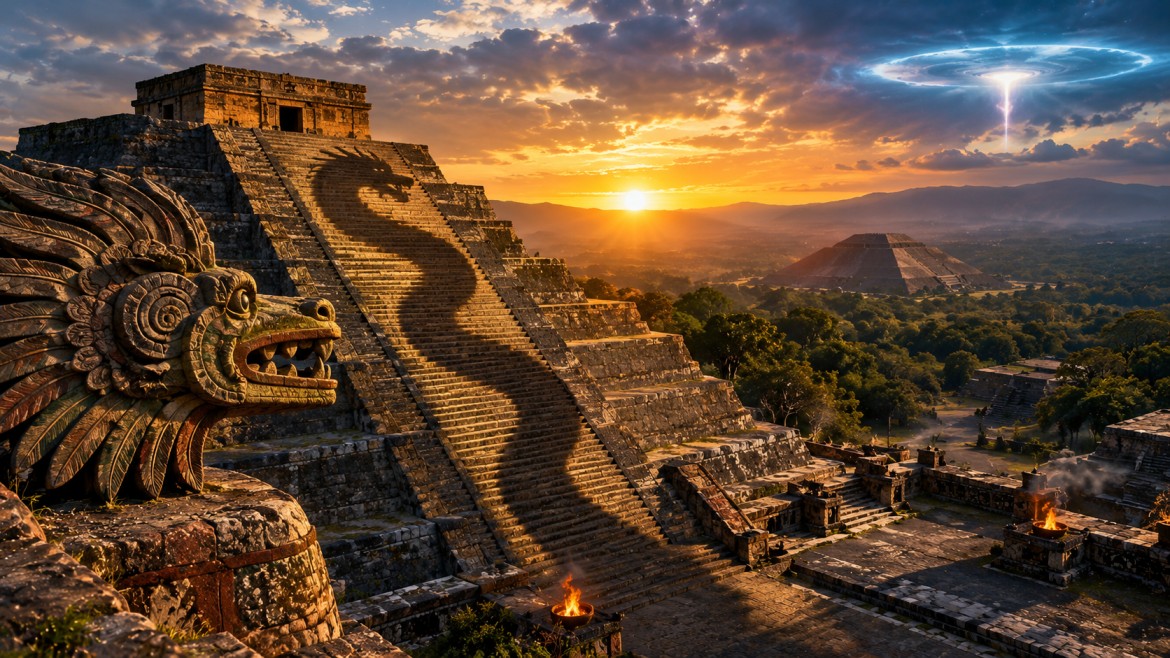
The Temple of the Winged Serpent is not simply given that name. According to the source, the pyramid contains hundreds of sculptures representing the serpent. This means that the winged serpent was physically incorporated into the architecture itself.
But another structure makes the connection even more striking. At El Castillo, a pyramid associated with the Maya, something unusual can reportedly be seen around the equinox. On this particular day, the position of the rising Sun creates a special pattern of light and shadow across the pyramid.
The shadow appears to form the shape of a large serpent moving down the structure. For the creator of the theory, this is more than an impressive architectural effect. He interprets it as an intentional representation of a serpent descending from an unseen doorway and entering the human world.
In other words, the pyramid itself may have been designed to tell a story.
- The Sun reaches a particular position.
- The pyramid produces a particular shadow.
- And the shadow creates the appearance of a serpent coming down from above.
Was the Serpent Really Coming From Another World?
This leads to a much bigger question.
The Maya and Aztecs had detailed knowledge of the movements of the Sun, Moon, stars, and planets. They carefully observed astronomical cycles and created sophisticated calendars. They also had traditions involving different worlds and doors between them. And some of their architecture appears to connect these ideas with specific astronomical events.
- So what exactly were they trying to represent?
- Was the winged serpent simply a religious symbol?
- Was it a mythological creature?
- Or could these ancient stories have been based on something that people believed they had actually witnessed?
The source takes the more mysterious possibility seriously:
- Perhaps these civilizations believed they had seen something coming through one of these doors.
- Perhaps the winged serpent represented a real creature from another world.
- Or perhaps the stories, rituals, and architecture were all different ways of describing an event that ancient people could not explain in modern terms.
There is no simple answer within the theory, but the pattern is difficult to ignore.
A Mystery That Leads to the Next Chapter:
The story has now brought together several unusual elements:
- The equinox.
- The movement of the Sun.
- Ancient astronomical knowledge.
- Doors between worlds.
- The Temple of the Winged Serpent.
- The Maya’s mysterious Xibalba.
- And legends of enormous winged serpents descending from the sky.
In my research, these are not isolated ideas. I believe they form part of a much larger pattern involving the possibility of hidden worlds and temporary passages between them.
But before revealing what I believe the winged serpent actually was, I want to introduce another part of my investigation: a place I believe was specially created as a home for mysterious creatures.
And according to the story, the next chapter is where those creatures finally begin to appear.