What if life exists beyond our world, but it does not look anything like the life we know?
This question becomes even more interesting when we consider the strange claims of explorer and natural scientist Ivan T. Sanderson, ancient stories about mysterious creatures, and what science tells us about the basic building blocks of life.
- If other worlds exist, what kind of life could they contain?
- Could there be creatures similar to animals on Earth?
- Could there be plants and ecosystems like ours?
- could life exist in forms that are completely unfamiliar to us?
To explore that question, we first need to understand what we actually mean when we use the word life.
Ivan Sanderson’s Strange Animal Sightings:
In earlier research, Ivan T. Sanderson was introduced as a British natural scientist who traveled extensively and studied animals around the world. Sanderson made an unusual observation during his travels. He claimed that magnetic fields and gravity could be slightly different in certain places compared with other parts of the world.
But some of his other claims were much stranger.
For example, Sanderson claimed that he had seen an enormous bat that he described as “the granddaddy of all the bats.” He also claimed to have seen giant penguins. At first, such claims might sound impossible. But when we look at the animals that exist, some interesting possibilities appear.
Could Sanderson Have Seen a Giant Bat?
Most bats people encounter are relatively small. But there are bats in the forests of the Philippines, Java, Sumatra, and Borneo that are very different from the tiny bats many people imagine.
The giant fox bat can become extremely large when it spreads its wings. According to the source, its wingspan can even exceed the height of a six-foot human. So is it possible that Sanderson had seen a giant fox bat and interpreted it as something extraordinary?
It is possible. But there is another important detail.
Sanderson was a zoologist. He studied animals professionally. He would have known much more about animal species and their sizes than an ordinary person. That makes his claims more difficult to dismiss completely.
What About the Giant Penguins?
There are currently many known penguin species, ranging from very small species to the much larger emperor penguin. The little penguin can be only around 35 centimeters tall, while an emperor penguin can reach around four feet. But the fossil record also contains evidence of penguins that were much larger than modern penguins.
The source describes a giant penguin fossil discovered in Antarctica that belonged to a bird larger than a six-foot man. Such giant penguins once existed but eventually disappeared. So could Sanderson have somehow encountered an unusually large animal?
Once again, there is no final answer. Perhaps he saw a known animal under unusual circumstances. Or perhaps his claim was describing something that was not an ordinary animal at all. Only Sanderson himself could have known exactly what he believed he had seen.
The Creature That Looked Like Nothing We Know:
Sanderson made another claim that is even more difficult to explain. He said that for a short period he saw an unknown creature. According to his description, it was neither clearly human nor clearly an ordinary animal. Its body was covered with a large amount of hair.
What makes this description particularly interesting is its similarity to the creature reported in Portlock, Alaska. The people of Portlock described a mysterious, hairy creature known in the source as Mantiak.
According to those accounts, sightings and alleged attacks of the creature were among the reasons residents eventually abandoned the settlement.
- Could the sightings in Portlock and Sanderson’s experience have been connected?
- Could creatures from another world somehow enter ours?
- And if mysterious doors between worlds really existed, could something living on the other side occasionally cross through them?
These questions connect the animal sightings with the larger theory explored throughout this series.
A Similar Creature in an Islamic Account:
The source also connects this idea with an account found in Islamic literature. It refers to a well-known hadith account involving Tamim al-Dari.
In that account, Tamim al-Dari reportedly encountered an extremely hairy creature. According to the description, the creature had so much hair that it was difficult to tell where its head ended and where its body began. The creature also spoke to him.
The source asks whether Tamim al-Dari and his companions could have been carried away from their normal route during a storm and somehow reached a place where such a creature existed.
This is presented as a question within the theory, not as a scientific conclusion.
- Could beings from another world ever enter our world?
- And could some of the strange creatures described throughout history actually be examples of such encounters?
To explore that possibility, however, we first need to answer a much more basic question.
What Is Life?
If we are going to imagine life on another world, we need to know what qualifies something as alive. According to the source, there are many different definitions of life, and no single definition is accepted for every situation.
However, one definition focuses on three important abilities.
The first is metabolism:
A living organism carries out chemical processes that allow it to obtain and use energy. Our bodies, for example, break down food and use it as energy.
The second is the ability to repair itself:
When our bodies are injured, they can begin repairing the damaged tissue. This ability is one of the characteristics associated with living organisms.
The third is the ability to replicate:
Living organisms can produce new organisms. Animals reproduce, plants reproduce, and even bacteria can reproduce by dividing themselves through a process known as binary fission.
So, according to this way of defining life, something that can carry out these basic functions would qualify as a living organism, regardless of how strange its appearance might be.
But what would such an organism actually be made of?
The Building Blocks of Life:
Human beings are made from chemical elements. The source explains that our bodies contain many different elements, although some are present only in very small amounts. Among these elements, six are presented as especially important building blocks of life as we know it:
carbon, hydrogen, nitrogen, oxygen, phosphorus, and sulfur.
These elements combine in different ways to create the chemistry that makes life possible on Earth. What makes this idea important when thinking about other worlds is that these elements are not limited to our planet. They exist throughout the universe.
Hydrogen is described in the source as the most abundant element in the universe. Oxygen and carbon are also widespread, along with other elements that are important to life as we know it.
This raises an intriguing question.
If the basic ingredients of life are spread throughout the universe, why should Earth necessarily be the only place where life developed?
The Cosmological Perspective:
This is where cosmology enters the discussion. Cosmology is the study of the universe as a whole. The source introduces two ideas associated with cosmology: the Copernican Principle and the Mediocrity Principle. The basic idea being explored is that Earth does not occupy a uniquely special position in the universe. Our planet revolves around the Sun, but the Sun is only one star among many.
Our Sun is also not located at the center of the Milky Way. It is situated in one of the galaxy’s spiral arms, described in the source as the Orion Arm. And the Milky Way itself is only one galaxy among an enormous number of galaxies.
The ingredients that make up Earth are also found throughout the universe. If our planet is not unique in its location or its basic materials, then perhaps life itself may not be unique either.
How Many Other Worlds Could Exist?
The source then turns to the Kepler space telescope. According to the source, Kepler was sent into space to search for planets around other stars. Its observations led to estimates involving enormous numbers of planets that could be similar to Earth.
The source presents a figure of around 40 billion Earth-like planets orbiting stars similar to our Sun. Even if we simply consider the possibility rather than treating that number as proof of life, the scale is difficult to imagine.
If only a small fraction of those worlds had conditions suitable for life, there could still be an enormous number of potentially interesting environments. The source then gives several examples of planets identified by Kepler, including Kepler-65f, Kepler-62e, and Kepler-186f.
These worlds are extremely far away. We may be able to observe some of them, but reaching them is an entirely different challenge. So if we cannot physically travel to these distant worlds, how can we imagine what life there might look like?
The source proposes using something humans already possess: deductive logic.
A House Full of Possible Creatures:
The creator describes a special place called the House of Creatures. It is presented as a conceptual way of imagining what life on other worlds could look like. The idea is not simply to invent random monsters.
Instead, the goal is to begin with what we know about life on Earth and then use reasoning to imagine how life might develop under different conditions. The source divides these possibilities into two broad groups.
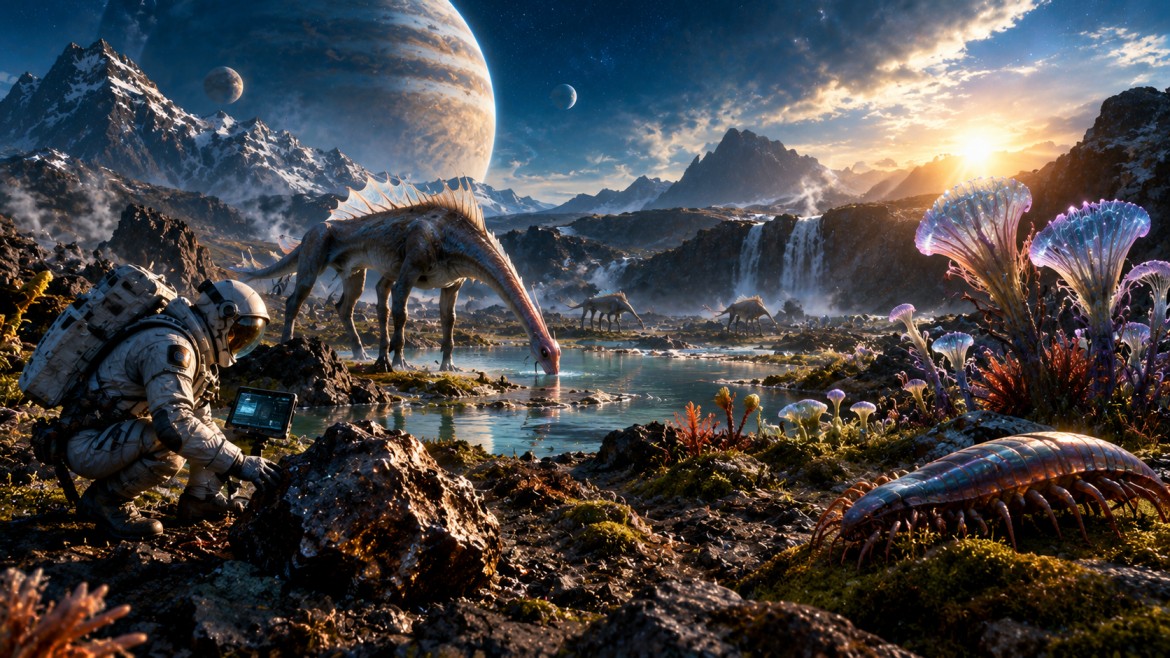
The first group contains creatures that might resemble life on Earth. They could include animals similar to our animals, vegetation similar to our plants, and ecosystems that follow patterns we already understand.
This would be life as we know it, but the second group is much stranger. It represents forms of life that humans have never encountered and perhaps cannot easily imagine.
- What if life does not need to look like an animal?
- What if an organism from another world has a completely different structure?
- What if its environment, chemistry, energy source, or physical conditions are so different that our usual idea of a living creature no longer applies?
Before imagining those creatures, however, the source introduces an important piece of evidence.
A Meteorite From Another World?
The story now moves to Antarctica. Meteorites from space fall to Earth in many sizes. Most are relatively small, but some contain material that can tell scientists something about where they came from.
According to the source, an unusual meteorite was discovered in Antarctica in 1984 by scientists working in the region. The meteorite was said to have come from a world where water had once existed. But the most important claim concerned what was found inside it.
The meteorite reportedly contained magnetite crystals mixed with carbonates. According to the interpretation presented in the source, this combination could indicate that the place from which the meteorite came had once contained life.
Even more interesting were structures described as fossil-like remains of microscopic organisms. The source presents them as being different from fossils found on Earth and appearing to exist in colonies.
If that interpretation were correct, it would suggest something far more significant than the existence of a single microscopic organism.
- It could suggest an ecosystem.
- A world where living organisms existed together in groups.
- A world where life interacted with its environment.
- Two Very Different Possibilities
- This brings us back to the House of Creatures.
- The first hall represents life that feels familiar.
- Animals.
- Plants.
- Trees.
Organisms that look and behave in ways that we can understand because they are based on life already known to us. The second hall represents something completely different. It contains the possibility of life that does not follow the patterns we are familiar with.
- A creature that might not resemble an animal.
- A living system that might not look like a plant.
- Or an organism whose physical form could challenge our understanding of what a living thing is.
The important point is that we currently know only one kind of life directly: life as we know it. We know the chemistry, biology, environments, and organisms that exist on Earth. But if another world has different conditions, its life could potentially take forms that are difficult for us to predict.
The Bigger Question:
The question is therefore not simply whether aliens exist. A deeper question is:
- What would life look like if it evolved somewhere completely different from Earth?
- Would it still require the same basic chemistry?
- Would it need metabolism, self-repair, and reproduction?
- Would it resemble animals and plants?
- Or could life exist in a form that does not fit our usual expectations?
The source’s argument begins with something very simple: the universe contains enormous numbers of stars, planets, and the chemical elements associated with life. From there, it moves toward a much more mysterious possibility.
If other worlds contain life, perhaps some of the strange creatures described throughout history could represent encounters with something that came from somewhere else.
The stories of giant bats, giant penguins, unknown hairy creatures, winged serpents, and other mysterious beings therefore become part of a much larger question.
- Are they misunderstandings of known animals?
- Are they legends that developed over time?
- Or could some of them represent encounters with forms of life that our world has never fully understood?
There is no final answer here.
But if the universe contains other living worlds, then the creatures living there may be far more diverse than anything humans have yet imagined. And that is where the journey into the House of Creatures truly begins.