
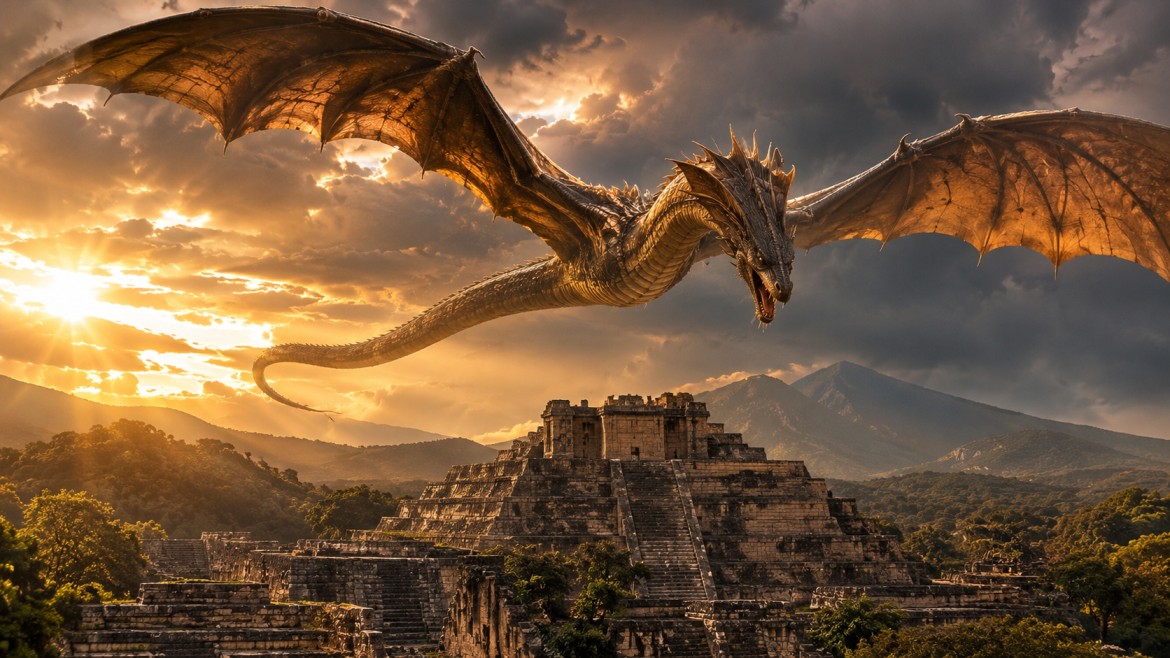
Across the world, ancient civilizations have described extraordinary flying creatures that resemble enormous serpents with wings, legs, and sometimes multiple heads. These creatures appear in mythology, historical accounts, religious traditions, and cultural celebrations. Their descriptions are surprisingly similar, even among civilizations separated by vast distances.
During my research for this chapter, I studied historical documents from thousands of years ago and from almost every major civilization. One thing that caught my attention was that reports of flying creatures were not limited to mysterious shiny objects. Many cultures also described another remarkable creature: a giant flying serpent.
Could these stories have originated from encounters with the same kind of creature? And is it possible that dragons once existed in our world?
The Winged Serpent of Ancient Mexico:
Let’s return to the third pyramid in Mexico that we discussed earlier: The Temple of the Winged Serpent.
One of the most fascinating features of this temple is its design. According to the account discussed here, it was constructed in such a way that, on one particular day of the year, when day and night are equal and the Sun and Earth reach a special position, sunlight creates the appearance of an enormous serpent descending from the sky along the pyramid.
What makes this especially interesting is that descriptions of giant flying serpents are not limited to South America. Similar creatures appear in the traditions of civilizations across the world.
Giant Flying Serpents in Ancient Mythologies:
Different civilizations gave these extraordinary creatures different names. The Sumerians described a giant flying serpent known as Mushussu, a creature believed to come from another world into ours. Ancient Indian Vedic texts also mention a gigantic winged serpent called Vritra.
In Greek mythology, a massive flying serpent with multiple heads appears under the name Hydra. Norse mythology has its own famous serpent-like creature, Fafnir.
There is also an ancient Latin term, Draconium, associated with the concept of a giant serpent. From the later English variation of this word came a familiar name that almost everyone recognizes today: dragon.
The concept of dragons also has a deep history in China. Their depictions can be traced back to the Neolithic period, when images of these creatures appeared on ancient objects and pottery.
Dragons became a fundamental part of Chinese culture. Many traditions, places, and cultural symbols are associated with them, including the Hair of the Dragon and Dragon City.
Even today, dragon-related celebrations can be found in Chinese, Japanese, and Korean cultures. Events such as the Lantern Festival and Spring Festival are among the celebrations associated with these traditions. The Spring Festival also takes place around the March equinox, a time connected with the special position of the Sun in the sky.
During these celebrations, people create different representations of dragons, recalling the image of a creature descending from the sky.
Chinese mythology also contains a fascinating story about a physician named Lu Xian Shen. According to the story, he once found a dragon lying injured on the ground in a forest, with damaged wings.
At first, the physician was terrified. However, he became concerned that the creature might die of hunger, so he decided to treat its injuries. After recovering, the dragon was able to fly again. As a gesture of gratitude, it took the physician with it to its own world.
Another familiar name connected with ancient dragon traditions comes from Zoroastrianism, one of the world’s oldest religions. In this tradition, a giant flying serpent called Azhidaha is mentioned. The name Azhdaha also came to be associated with the idea of an enormous serpent.
Ancient Iranian war flags sometimes depicted a dragon alongside the Sun. According to the interpretation presented here, this represented a giant serpent associated with the Sun’s special position and symbolized strength in battle.
Interestingly, the concept of a dragon appears in almost all Proto-Indo-European mythologies. This alone is fascinating, but there is something even more remarkable: dragons are not mentioned only in mythology. Some accounts also describe them as historical sightings.
Historical Accounts of Giant Flying Serpents:
Around 247 years after the birth of Jesus Christ, a sophist named Lucius Flavius was said to have lived in Greece. A sophist was a person skilled in multiple fields of knowledge, such as philosophy, mathematics, and biology. He is described in this account as the first person to record an eyewitness report of a dragon in Ethiopia in a historical book.
The book is identified as Apollonius of Tyana. In it, he reportedly describes seeing enormous flying serpents descending from the sky in Ethiopia and hunting elephants. The idea of giant flying serpents appearing in historical accounts, rather than only in mythology, adds another layer to the mystery.
Dragons in Religious Traditions:
Perhaps the most surprising aspect is that descriptions of enormous serpents also appear in religious texts.
In Christianity, the Bible mentions a great and powerful creature called Leviathan, described in the Book of Job 41:1–34. Other serpent-related references are also mentioned in Deuteronomy 8:15 and Numbers 21:4–9.
The account in the Book of Numbers also describes a serpent associated with fire.
At this point, there is another religious tradition worth examining: Islam.
During this project, much of the information I found useful came from Islamic accounts. You may have noticed that Islam has provided more references in this project than any other religion, because I believe it offers the most logical and realistic explanations among religious traditions.
So, does Islam also contain an account of a giant flying serpent?
The answer is Yes.
Imam Qurtubi reported an account from Wahb ibn Munabbih. For those unfamiliar with Wahb ibn Munabbih, he was a Tabi’i born during the era of Caliph Uthman, approximately twenty-two years after the time of Prophet Muhammad (peace and blessings be upon him & his family ). He received his education directly from the Companions.
According to the account attributed to Wahb ibn Munabbih, when Adam (peace be upon him) was in Paradise, Satan wanted to reach him and mislead him. To enter Paradise, Satan reportedly sat inside the mouth of an enormous serpent.
This serpent had legs. However, after the betrayal, its legs were taken away, and it was condemned to crawl.
When we bring all these accounts together, an interesting question emerges. Could dragons, or enormous winged serpents, really have been seen arriving in our world from somewhere else?
Consider the Maya civilization. One of its great deities was known as Kukulkan, a giant flying serpent associated with the Sun and its special celestial events. According to the interpretation explored here, this creature emerged from its own world and entered ours during events such as a solar eclipse.
Could the Maya have witnessed something resembling a dragon descending from the sky and then begun worshipping it as a god?
These are questions worth exploring.
Could a Giant Dragon Actually Fly?
We are still inside the House of Creatures, in the hall containing beings that we do not yet know and have never seen with our own eyes. As I explained earlier, I have not designed the creatures in this house using imagination or guesses alone. No matter how strange they may look, I have designed them while keeping the laws of nature in mind.
This brings us to an important question: Could an enormous serpent-like creature with wings actually exist and fly?
To explore this possibility, we need to travel back approximately 65 million years, to a time when dinosaurs inhabited our world. Dinosaurs belonged to the reptile family, which includes animals with dry scales on their bodies, such as snakes, large lizards, and crocodiles.
Many reptiles can run across the ground, and dinosaurs could also run. Reptiles can also climb using their claws, and dinosaurs were capable of climbing as well. However, the ability to fly is not something that every animal can develop easily.
Anyone familiar with the requirements of flight understands that an enormous dragon-like serpent might be capable of flying in a world with lower gravity. But flying in our world, where gravity is stronger, would be a much greater challenge.
Large animals generally have greater body weight, making powered flight difficult for them. However, nature has developed some fascinating ways for animals to move through the air.
Animals That Glide Through the Air:
If you visit the rainforests of Borneo and Indonesia, you can witness an extraordinary sight.
High above the ground, in the upper layers of tall trees known as the canopy, some animals have developed a special ability that helps them escape predators. They can leap from one tree canopy to another and travel considerable distances through the air.
This ability is called Gliding.
Flying squirrels are one example. They can glide for distances of up to 650 feet, creating the impression that they are flying. But this phenomenon is not limited to rainforest canopies. Similar movement can also be observed among creatures living in the sea.
If you are thinking about flying fish, you are partly right. Some fish can suddenly leap out of the water to escape predators and then glide for several hundred meters. From a distance, it can look as though they are flying.
There are many large animals capable of gliding, but gliding is not the ability I want to focus on here. I want to discuss something much rarer: powered flight.
Powered Flight: One of Nature’s Rarest Abilities
Powered flight is the ability of an animal to use its own body to generate aerodynamic force strong enough to lift it off the ground and keep it moving through the air. Flying might seem ordinary to us, but powered flight is an extraordinary and demanding ability. It requires a highly specialized body.
It is such a rare gift that, according to the explanation presented here, it has developed in only four groups of creatures: insects, birds, bats, and one more group that we are about to explore. The animals mentioned so far are generally small. Until the discovery discussed next, we had not seen larger animals capable of powered flight.
In 1784, however, a fossil belonging to a fourth flying creature was discovered: a giant prehistoric reptile measuring approximately 25 feet. This creature is identified in the account as Pteranodon, and its ability to fly was connected to two remarkable features of its body.
The first was a stretched membrane extending from its ankles to the claws of its arms. This membrane generated the aerodynamic force needed to lift its enormous body into the air. It also looked somewhat like a pair of wings.
The second feature was its bones. They were extremely thin, almost like paper, and filled with air. This made its body incredibly lightweight, allowing it to fly much more easily.
When the Pteranodon fossil was discovered, scientists were astonished. Could a reptile-like creature of such enormous size really fly?
For a time, it seemed that this might be the largest creature capable of flight. But that assumption was soon challenged.
An Even Larger Flying Creature:
Not long afterward, the fossil of an even larger prehistoric flying creature was discovered: Quetzalcoatlus.
When it spread both wings, its total wingspan could reach approximately 36 feet. Compared with this enormous creature, Pteranodon could seem almost like a child.
What makes this even more interesting is the idea that the bodies of these creatures were designed in such a way that they could potentially have flown even if they had grown considerably larger.
These prehistoric flying creatures demonstrate how extraordinary body structures can make flight possible even at enormous sizes. And this brings us back to dragons.
Dragons are not necessarily impossible creatures. Within the laws of nature, their existence may be possible.
If they lived in worlds with lower gravity and higher oxygen levels, they could potentially grow much larger than the flying creatures we know. Perhaps this could explain the enormous dragon-like forms that appear in the traditions of so many different cultures.
Who knows through which doors these creatures might have entered our world? People across different civilizations described them, and the Maya even built an entire temple, the Temple of the Winged Serpent, to represent the image of a giant serpent descending from above.
How long might these creatures have visited our world? According to the historical account discussed earlier, they were even seen hunting elephants in Ethiopia. Another story describes an injured dragon found in a Chinese forest.
But if dragons really existed under the laws of nature, if they entered our world, and if they hunted elephants, where are their fossils?
Why Are There So Few Fossils of Giant Flying Reptiles?
The answer may be hidden in the fossil record of these prehistoric flying reptiles.
These creatures existed and flew through our world for approximately 160 million years. They hunted and survived for an extraordinarily long period. Yet only around thirty fossils of these creatures have been discovered.
Why have so few survived?
The reason discussed here is the unusual structure of their bones. Fossils generally form from bones, but the bones of these reptiles were extremely hollow and thin. They could break apart very easily and eventually become part of the surrounding soil.
The few fossils that survived did so because they were buried under exceptionally favorable conditions.
Their bones remained at suitable temperatures, inside suitable swampy soil, and under the right amount of pressure. Instead of breaking into pieces, they were preserved and eventually became fossils.
This detail about swamps is particularly important, and I will discuss it in more detail in a later chapter.
Are Dragons a Reality?
Within the House of Creatures, dragons are a reality.
Did they really leave their own worlds and descend into ours? Who knows?
But the evidence of their presence can be found everywhere—in the traditions of different civilizations, in ancient religious accounts, in historical reports, and in the stories passed down through generations.
What kind of doors are these? And what kinds of worlds might exist behind them?
From this point onward, the most astonishing part of this chapter is about to begin: the doors themselves.