If mysterious doors could open between our world and another world, the biggest question would not simply be how to open them.
It would be much more interesting to ask:
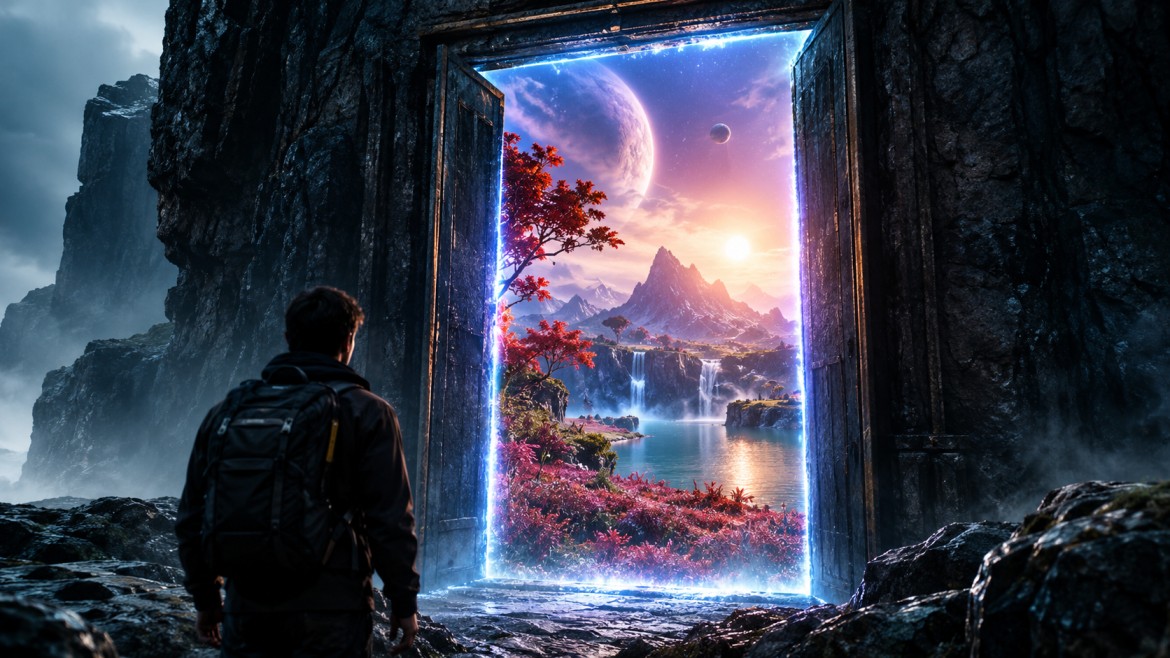
What would we find on the other side?
The idea sounds impossible at first. Yet mathematical models have explored the possibility of passages that could connect different regions or worlds. The problem is that mathematics and physical reality are two very different things.
We may be able to describe such a doorway mathematically, but that does not mean we currently have the material or energy needed to open one.
So, if these doors cannot yet be opened by humans, what could possibly exist beyond them?
We May Know the Mathematics, But Not the Key:
According to the theory discussed here, humans have already developed mathematical ideas that describe how such a doorway might work.
But physically, we still lack two important things.
- First, we do not have the material capable of affecting or opening such a door.
- Second, we do not have enough energy to keep it open.
It is like knowing that a locked door exists while having no key to open it. One natural process that might open such a passage has also been proposed.
The transcript connects this idea with physicist Leonard Susskind and his 2013 research paper, ER = EPR. The mathematics behind the paper is extremely complex, but the basic idea presented here is that opening such a passage can be considered mathematically possible.
Our engineering, however, is not yet capable of opening one whenever we want.
The Mystery of Exotic Matter:
The material that could supposedly influence such a doorway is described as exotic matter. According to the theory, these are forms of matter that are still poorly understood. The transcript describes several different kinds of matter that may exist in the universe.
There is ordinary matter—the material that surrounds us every day.
Then there is antimatter, which humans have produced in laboratories but could only observe for a very short period. Beyond these are other forms of matter whose existence is discussed but whose nature remains difficult to understand.
One example mentioned is dark matter. Its presence is suggested by the way its gravity affects other objects, even though we cannot directly see it.
Another is mirror matter, a particularly unusual form of matter that is introduced as another possibility.
These examples lead to an important idea:
The universe may contain forms of matter that behave very differently from the ordinary matter we know. And if a mysterious doorway requires an unusual type of matter, perhaps that is one reason humans have not learned how to open such doors physically.
Imagining a World Beyond the Door:
At this point, the discussion moves from known facts and mathematical ideas into imagination. But the imagination is supposed to remain within the basic rules of nature. If we entered such a doorway, the theory suggests that we could find ourselves in an entirely different world.
Our connection with the previous world might disappear. The new world could contain forms of matter that we have never encountered before. It might even contain substances that block our path because we would not know how to move through them.
But the theory offers another possibility. Perhaps we would not need to pass through such material directly.
A New Dimension Could Create a New Path:
The transcript introduces an idea called Gauss-Bonnet gravity.
According to the explanation given, the way around an obstacle would not necessarily be to travel through it. Instead, a new path could be created by adding another dimension. This leads to a much bigger possibility.
If we entered the doorway, we might not simply travel to another location in our own three-dimensional world. We could enter a different realm in which our normal understanding of dimensions no longer applies in the same way. Time, direction and even the meaning of life could appear completely different.
That raises another question:
Would there be anything alive on the other side?
The First Thing We Might See:
If another world exists, the first thing we might notice could be its vegetation. Plants and trees contain chemical information that can be detected through the light they reflect. The color of vegetation can therefore provide clues about the conditions of a world.
Our own planet looks green because of the way plants interact with sunlight. Plants absorb sunlight and convert its energy into chemical energy through photosynthesis. The substance responsible for absorbing the light is chlorophyll.
Chlorophyll absorbs many colors of sunlight but does not absorb green light in the same way, leaving green light to be reflected back toward our eyes. That is why Earth’s vegetation appears green. But another world may have a different star. And that could completely change the appearance of its plants.
A Red or Black World?
If the star of another world had somewhat different conditions, its vegetation could look very different from ours. The transcript suggests that if the temperature of the light from that world’s star were higher, its plants could appear red.
If the available light were weaker, the plants might become extremely dark, even appearing black, so that they could absorb as much of the available light as possible.
In other words, plants would not necessarily have to be green. Their appearance could depend on the light available on their world.
Was Earth Once Purple?
There is another fascinating possibility in the theory. The plants on Earth may not always have looked the way they do today. The transcript refers to changes in photosynthesis and introduces retinal, a basic pigment described as a precursor to chlorophyll.
According to the account, when retinal was present in early forms of life, the world may have appeared purple rather than green. Some researchers, as described in the transcript, suggest that retinal is a very basic pigment.
If similar chemistry develops first on other worlds, then perhaps purple vegetation could be common elsewhere in the universe. This would mean that the first glimpse of another world might not be green at all.
It could be purple, red, black—or a color we have never seen in the vegetation of our own world.
A Possible Clue From Flight 19:
The theory connects this idea back to Flight 19. One of the pilot’s reported descriptions involved confusion about the color of the sky—green, then white, and then green again.
According to the theory, this could have been more than ordinary confusion.
If the pilot was somehow looking toward another environment, the colors of its vegetation might have influenced what he saw. However, the transcript considers this report less important than two other accounts.
Both are connected to Islamic tradition.
A Report About a Door to Paradise:
The first account describes an event during a prayer performed during a solar eclipse.
According to the report, the Prophet Muhammad (S.A.W.W) stood for an unusually long time, then performed a long bowing and prostration. After the prayer, his companions asked why he had suddenly reached forward and then moved back.
The explanation given in the account was that a door to Paradise had opened before him. He reportedly saw grapes and reached toward them, intending to bring them to his companions. According to the report, a barrier then prevented him from doing so.
The transcript draws attention to one particular detail:
The event occurred during a solar eclipse. In the theory being explored, this is significant because a solar eclipse places the Earth and Sun in a particular position.
The account therefore sees a possible connection between the Sun, a special position of Earth, and the opening of a doorway.
Another Description of a Different World:
The transcript then discusses another report from Islamic tradition concerning the Prophet Muhammad ﷺ and his journey to another realm.
According to the account, after the doors of the heavens were opened, he saw a great tree.
Its roots extended through the sixth heaven, while its branches reached the seventh.
Its leaves were described as being extremely large, and its fruits were compared with large vessels.
But the most unusual part was its colors.
The account describes the tree as changing colors so rapidly and beautifully that the colors were beyond ordinary human description.
It also mentions golden-colored creatures flying around the tree. Once again, the first major feature described in this other realm is vegetation. For the theory, this is an important pattern.
If a doorway led to another world, perhaps vegetation would be among the first things visible there.
A Journey Through Ancient European Beliefs:
The discussion then moves from Islamic accounts to ancient European traditions. The transcript mentions the old cultures and beliefs of the Baltic countries, including Estonia, Latvia and Lithuania. It also discusses Nordic, Slavic, Germanic, Greek and Roman mythologies.
These cultures had different gods and different beliefs. Yet the transcript points to something they shared: a festival associated with the period around June 21.
This is known as the Midsummer Festival.
During the festival, people in different European cultures traditionally used flowers, fires and other symbolic practices. Women could wear flower crowns or place flowers beneath their pillows. Large bonfires were also part of the celebrations, with people gathering around them.
In some historical traditions, people even walked over burning coals or jumped over fires. The transcript also mentions animal sacrifices as practices that existed in some places in earlier periods. Many of these practices have since declined, and Midsummer is now largely treated as a celebration or form of entertainment.
But the transcript asks an interesting question:
Why did different cultures with different gods and beliefs share a festival around the same time of year?
And why has the timing remained connected to June 21 for thousands of years?
According to the theory, ancient people may have recognized a special natural phenomenon associated with this date.
Searching for a Pattern:
The theory has now brought together several very different ideas.
- There are mathematical models of possible passages.
- There are unusual forms of matter.
- There is the possibility of different dimensions.
- There are worlds whose vegetation might look completely different from Earth’s.
- There are historical accounts describing doors opening into another realm.
- There are strange reports associated with the sky and missing aircraft.
And there are ancient cultures whose traditions appear to be connected with important positions of the Sun. None of these pieces, by themselves, proves that mysterious doors between worlds exist. But within the theory, they form a pattern worth examining.
The central question is no longer simply whether a doorway can exist.
It is now something much bigger:
If such a doorway opened, what would the world beyond it actually look like?
- Perhaps its plants would not be green.
- Perhaps its colors would be completely unfamiliar.
- Perhaps its dimensions would not follow the rules we experience every day.
And perhaps the strange descriptions found in old reports are not random details at all—but clues to what may lie beyond the door. The next question is therefore unavoidable:
What exactly is on the other side?