
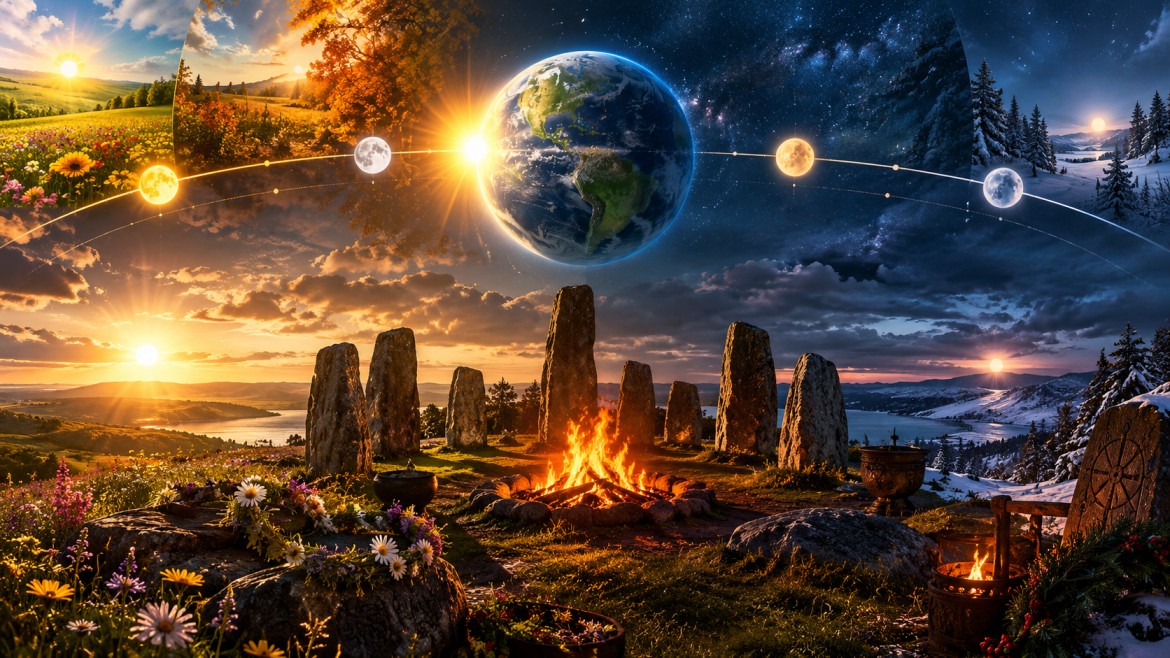
Every year, there are four dates when something unusual happens in the relationship between Earth and the Sun.
These dates mark important changes in Earth’s position and are connected with the changing seasons. But ancient cultures noticed something else about these days. They did not simply see them as changes in the seasons. They treated them as moments of transition—times when one phase seemed to meet another.
According to the theory explored in this article, ancient people may have believed that these special positions of Earth and the Sun were connected with mysterious doors between different worlds.
The four dates are the two solstices and the two equinoxes.
Why Are These Four Days Special?
Earth travels around the Sun while also rotating around its own axis. During its yearly journey, there are four important points. Around September 23, Earth reaches the autumn equinox. Around December 21 comes the winter solstice. Around March 20 comes the spring equinox. Finally, around June 21 comes the summer solstice.
The equinoxes are associated with a balance between day and night, while the solstices mark the longest and shortest days of the year. The summer solstice, around June 21, is particularly important because it produces the longest day of the year.
Ancient people noticed these changes thousands of years ago. But according to the theory discussed here, they may have noticed something more. They may have believed that these four moments were not only transitions between seasons. They may have regarded them as moments when two worlds could somehow meet.
The Mysterious Flower of Midsummer:
One of the most interesting examples comes from the European Midsummer celebrations around June 21. Today, wearing flower crowns or placing flowers beneath a pillow may look like simple traditions. But the transcript connects these practices with much older Baltic mythology.
According to the old stories described here, people once reported seeing a strange and beautiful flower around the time of the summer solstice. The flower was said to change color, first appearing yellow and later becoming red. Even more unusual was the belief that this flower did not normally grow in the local forests.
People in different parts of Europe reportedly associated it with another world.
In some traditions, people would enter forests during Midsummer in the hope of finding or seeing the mysterious flower. The transcript connects these traditions with countries including Russia, Ukraine and Belarus, while also describing flower-related Midsummer customs in Poland, Romania, Sweden, Slovenia and Norway.
In some places, flower crowns became a symbolic reminder of this mysterious flower. In Norway, flowers were traditionally placed beneath pillows, with the hope of seeing the flower in dreams.
The theory presented here is that these customs may preserve a very old memory of a mysterious flower that people believed they had seen when a doorway between worlds briefly opened.
Why Was Fire So Important?
Flowers were not the only important part of Midsummer. Large bonfires were also traditionally lit. The transcript argues that these fires are much older than Christianity and were not originally connected to Saint John.
Similar fire traditions are described in different countries and cultures. People gathered around the fires, danced, and celebrated. Some older traditions also involved jumping over fires or walking across hot coals.
The question is:
Why was fire so closely connected with these celebrations?
According to the theory, the answer may lie in the same mysterious world described through the flower stories. The old accounts say that the strange flower was protected by supernatural creatures. These creatures were believed to sometimes enter our world to protect the flower.
Fire was therefore seen as a form of protection. People believed that large fires could keep these beings away from them. The bonfires may also have been viewed as something that could attract these mysterious beings—or perhaps even help open the doors themselves.
The transcript leaves that final possibility as an unanswered question.
Fire as a Symbol of Protection:
The importance of fire goes far beyond Midsummer.
Ancient European cultures sometimes viewed fire as a protector. It provided light in darkness and was believed to protect people from dangerous forces. Fire also became important in several ancient religious traditions.
The transcript discusses Zoroastrianism, ancient Indian Vedic traditions, Roman traditions surrounding Vesta, and the symbolic importance of fire in Judaism and Christianity.
One explanation for fire’s importance was its unique nature.
- Water can become dirty.
- Earth can become polluted.
- Air can become contaminated.
But fire consumes what is placed into it. Fire also naturally rises upward, unlike water, earth and ordinary air. Because of this, ancient people could see fire as something pure, powerful and connected with the heavens.
The theory presented here gives this upward movement another possible meaning: fire may have been associated with the mysterious doors that were believed to connect different worlds.
The Winter Solstice and Another Door:
The summer solstice was not the only important date. The winter solstice, around December 21, represents almost the opposite condition. It is associated with the shortest day and the longest night of the year. Ancient cultures also recognized this event and created traditions around it. The transcript gives an example from ancient Iranian mythology.
According to the account, the winter solstice was considered a time when the Sun and Earth reached a special position. Ahriman, described as an evil being in Zoroastrian tradition, was believed to emerge from another world during this period.
This was connected with the ancient Iranian festival that became known as Shab-e Yalda. Families and friends gathered together, ate, drank and spent the night together. The transcript connects this tradition with the belief that the night represented a special time when the boundaries between worlds could become open.
Red foods such as pomegranates and watermelon were also important parts of the celebration.
Saturnalia and the Release of Saturn:
Another example comes from the Roman festival of Saturnalia. According to the transcript, the Romans held a festival around the winter solstice in honor of Saturn. The feet of the statue of Saturn were traditionally tied with wool.
During the festival, the wool was removed. The act symbolized freedom. The theory presented in the transcript interprets this as a symbolic representation of Saturn being released from another world and entering our world through a doorway.
Again, the important theme is the same:
A special astronomical moment, a festival, and the idea of something crossing between worlds. The Sun and the Origins of Christmas The transcript then connects the winter solstice with another major celebration: Christmas.
It describes an older tradition called Sol Invictus, associated with the Sun. The Sun was connected with twelve months and twelve zodiac signs. The transcript argues that later traditions replaced some of these solar symbols with Christian ones, including Jesus and his twelve apostles.
The vegetation associated with older traditions was also symbolically transformed into the Christmas tree. The argument is not simply that different cultures celebrated the same date.
It is that traditions may have changed their symbols while retaining ideas associated with the Sun and its special position in the yearly cycle.
What About the Equinoxes?
The two equinoxes are also important. Around March 20 and September 23, day and night are described as being approximately equal. The word equinox itself is associated with the idea of equal nights. The transcript points out several unusual features associated with these dates, including the equal illumination of Earth’s hemispheres.
Different cultures also created festivals around the equinoxes. In Pakistan, the March equinox is connected in the transcript with the festival of Basant and the agricultural cycle. In Iran, the March equinox marks Nowruz, the Iranian New Year. But the history goes much further back.
The Babylonian Connection:
The transcript takes us approximately four thousand years into the past, to ancient Babylon. The Babylonians also connected their New Year with the March equinox. But according to the mythology described here, the goddess Inanna was believed to descend through a doorway and enter the world.
The famous Ishtar Gate is then presented as a symbolic representation of that doorway. People passed through the gate toward the temple associated with Inanna. In this interpretation, the physical gate became a symbolic representation of a divine being entering our world through another realm.
Equinox Traditions in Norse Mythology:
The transcript also describes a Norse festival associated with the equinox. It mentions a ritual connected with beings believed to descend from above. The details are presented as part of an ancient belief system in which supernatural beings could cross between different realms.
This creates another example of the same pattern:
- An astronomical event occurs.
- A festival is created around it.
- And mythology describes beings or forces moving between different worlds.
A Pattern Across Ancient Cultures:
At this point, the theory begins connecting many traditions that developed in very different parts of the world.
- The summer solstice is associated with mysterious flowers, vegetation and protective fires.
- The winter solstice is associated with long darkness, supernatural beings and celebrations involving the Sun.
- The equinoxes are connected with balance between day and night, agricultural festivals, New Year celebrations and stories about beings descending through doors.
The writer’s central idea is that these similarities may not be random. Perhaps ancient people observed unusual events during these specific astronomical moments. Perhaps they believed they had witnessed openings between worlds.
And perhaps those experiences influenced their mythology, rituals and festivals for thousands of years.
The Four Days as Ancient Transitions:
The four astronomical dates therefore become much more than calendar events within this theory. They become four transition points.
- At the summer solstice, Earth reaches one extreme in its relationship with the Sun.
- At the winter solstice, it reaches the opposite extreme.
- At the equinoxes, the relationship reaches a point of balance.
The theory suggests that ancient people may have considered these moments particularly important because they believed the boundary between worlds became weaker.
The flowers, bonfires, festivals, supernatural beings and solar traditions could then be understood as cultural memories of those supposed encounters.
Of course, this is the interpretation presented by the source, not an established explanation of how the universe works. But it provides a striking way to look at traditions that have survived for thousands of years.
Why June 21 and December 21 Matter So Much:
Modern people may look at Midsummer, Yalda, Christmas or other seasonal festivals simply as cultural celebrations. But behind many of them are traditions that are far older than the modern versions we know today.
- The symbols have changed.
- The names have changed.
- Religions and cultures have changed.
Yet the dates remain connected with the position of Earth and the Sun. The theory explored here asks whether this continuity could have a deeper origin.
- Could ancient people have witnessed something they interpreted as a doorway between worlds?
- Could the strange flower traditions represent the vegetation of another world?
- Could fire have been used as protection from beings believed to cross through those doors?
- And could later religious traditions have preserved traces of much older ideas?
There is no simple answer to these questions.
But one thing is clear from the stories discussed here: the four major astronomical transition points have influenced human cultures for thousands of years. The deeper mystery is what ancient people believed they were seeing when they looked toward the Sun, the sky and the changing seasons.
Perhaps they were simply creating stories to explain the natural world. Or, according to the theory explored in this article, perhaps some of those stories began with experiences that ancient people believed were far stranger than anything we see today.