
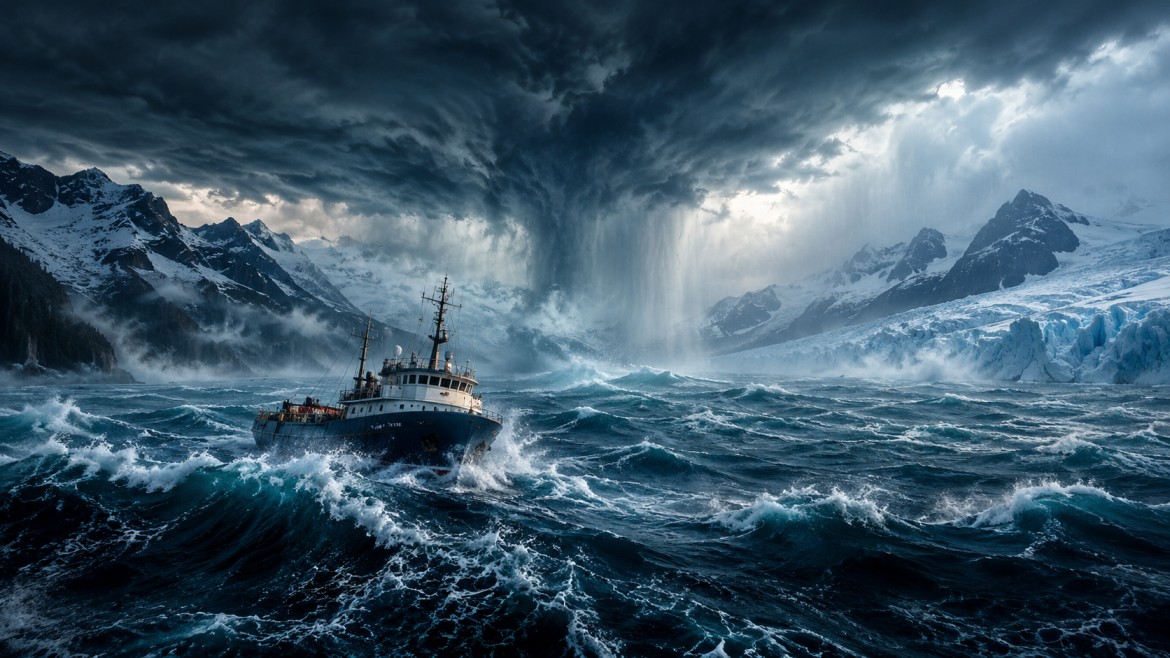
The Bermuda Triangle has long been associated with mysterious disappearances, but not every explanation has to involve something supernatural. There are several natural forces that could potentially explain at least some of the strange incidents reported in the Bermuda Triangle and Japan Triangle.
However, when these explanations are examined closely, they do not seem to answer every question. The same problem becomes even more complicated when we look at the Alaska Triangle, where the environment is completely different.
Was Inexperience Really the Problem?
One explanation for the disappearance of HMS Atalanta in 1880 is that its crew may have been inexperienced. It is possible that they lost their way and eventually became victims of a storm.
But around forty years later, another large American vessel, the USS Cyclops, disappeared in the Bermuda Triangle. Its crew could hardly be described as inexperienced because the ship was a large merchant vessel.
Only a few years after the disappearance of the Cyclops, another unfortunate vessel was reportedly found drifting through the waters of the Bermuda Triangle. The ship itself appeared to be intact. There were no obvious signs that it had been destroyed by a natural accident, yet its entire crew had mysteriously disappeared.
A similar incident reportedly occurred in 1955 when a pleasure yacht was found drifting near the Bermuda Triangle. Everything on the boat appeared to be in place, but its crew was nowhere to be found.
What makes this case particularly interesting is that the yacht had apparently survived three storms during its journey, including the notorious Hurricane Loni.
Then there is Flight 19. Its leader, Charles Carroll Taylor, reportedly had around 2,500 hours of flying experience. These were not amateurs who simply did not know how to operate an aircraft.
Experience, therefore, may not be enough to explain every disappearance. Even highly experienced people can sometimes become helpless when confronted with the power of nature.
This raises another possibility: could natural disasters have been responsible for some of these disappearances?
The Gulf Stream:
One possible explanation comes from the ocean itself: the Gulf Stream.
The Gulf Stream can be thought of as a river-like flow moving through the ocean. At times, such powerful moving water can carry objects that come into its path along with it.
If such a powerful current encountered a large vessel such as the USS Cyclops, it is possible that the vessel could have been carried away, damaged along the way, and eventually broken apart. Its remains could then have been scattered over a huge distance beneath the ocean.
This could potentially explain why the remains of some vessels might be difficult to locate.
But there is an obvious problem.
The Gulf Stream is an ocean phenomenon, while some of the disappearances involve aircraft. A current in the ocean cannot by itself explain what happened to an airplane flying through the air.
So although the Gulf Stream might provide a possible explanation for some maritime disappearances, it does not answer every question.
Could Sea Storms Explain the Disappearances?
Another possible explanation is severe weather.
Storms can affect both ships and aircraft. During a storm, losing one’s way can become much easier, and powerful weather conditions can create serious difficulties for anyone travelling through the area.
However, these disappearances did not necessarily happen centuries ago, when weather forecasting was unavailable. Weather-warning systems capable of providing information about approaching storms already existed decades ago.
Such systems could provide information about the weather ahead and help vessels determine whether they should continue along their planned routes.
There is another problem as well.
Some disappearances reportedly occurred when there was no obvious storm at all.
For example, when Flight 19 disappeared in the Bermuda Triangle, the sun was reportedly shining brightly. Similarly, when an A6M Zero aircraft disappeared in the Japan Triangle, there was reportedly no storm or bad weather in the area.
Even if we assume that weather-warning systems somehow failed to provide useful information, another question remains.
After some vessels disappeared, search-and-rescue ships were sent to look for them. These vessels were designed to deal with difficult weather conditions, including storms. Yet the transcript also raises the claim that search-and-rescue vessels themselves disappeared.
For that reason, ordinary storms do not appear to answer every question either.
The Sudden Force Known as an Air Bomb:
A third possible natural explanation is something described in the transcript as an “air bomb.”
This phenomenon reportedly became known more widely after an incident involving the American ship Pride of Baltimore in 1986.
During its journey, the normal wind speed of around 32 kilometers per hour suddenly increased to approximately 145 kilometers per hour. The powerful air movement was coming downward from above.
A similar report was associated with the Brazilian ship Concordia in 2010, when downward-moving winds were reportedly travelling at around 270 kilometers per hour.
The phenomenon is described as a downdraft of cold air. Extremely cold and powerful air can suddenly move downward toward the surface of the water or land. When it reaches the surface, it can spread outward rapidly.
Anything caught directly in its path could potentially be damaged or broken apart.
This raises another possibility: could sudden air-bomb events have contributed to some aircraft or ship disappearances?
It is possible, but this explanation also leaves important questions unanswered.
If an aircraft or ship were destroyed by such a powerful force, some wreckage might still be expected to remain. More importantly, this explanation does not account for cases in which a vessel was reportedly found apparently intact while its crew was completely missing.
So once again, a natural explanation may answer one part of the mystery while leaving another part unresolved.
What About the Alaska Triangle?
The Bermuda Triangle and Japan Triangle are largely associated with ocean disappearances, but the Alaska Triangle presents a very different situation.
Storms at sea cannot explain disappearances in an area located on land. An air bomb could potentially occur there, but could such weather phenomena really explain the thousands of reported disappearances mentioned in the discussion?
Another possible explanation lies in Alaska’s geology and difficult terrain.
Alaska is described as one of the world’s least explored areas. It contains dense forests, hundreds of large glaciers, deep cracks and crevasses, and extremely deep caves.
In such an environment, a person, vehicle, or aircraft could potentially fall into a hidden opening and disappear from sight. Something could remain buried or hidden for a long time without anyone knowing exactly where it went.
According to the transcript, people really do disappear in these difficult environments. The surprising part is not simply that people can become lost there, but the large number of missing people reportedly associated with the region.
The discussion states that the number of missing people is more than twice the average reported for other U.S. states.
But there is another important point.
The people entering these mountains, glaciers, and forests are not necessarily inexperienced amateurs. Many of them receive proper training before entering such difficult environments.
One example mentioned is Gerald D. Berry, who was himself a member of a search-and-rescue team. He had survival training for dealing with dense forests and snowy mountain peaks.
If even experienced and trained people can disappear in such an environment, the terrain itself becomes an important part of the mystery.
More Questions Than Answers:
After considering human error, bad weather, ocean currents, sudden air movements, and the difficult geology of Alaska, the mysteries do not seem completely solved.
The natural explanations may provide possible answers for individual incidents, but they do not appear to explain every disappearance discussed here.
The Gulf Stream might offer a possible explanation for some vessels, but it cannot explain aircraft.
Storms can affect both ships and planes, yet some disappearances reportedly occurred without obvious storms.
Air bombs could potentially cause sudden destruction, but they do not explain every case involving apparently intact vessels and missing crews.
And in Alaska, the difficult terrain, forests, glaciers, cracks, crevasses, and caves could provide places where people or vehicles might disappear without being easily found.
So instead of producing one simple answer, these explanations create even more questions.
The world may be far less completely understood than we sometimes assume. The Bermuda Triangle, Japan Triangle, and Alaska Triangle each present different environments and different possible explanations, but the traditional explanations discussed here still leave significant uncertainties.
And that uncertainty is precisely what leads to the decision to look beyond these conventional explanations and investigate the cases further. In the next article, we will explore the strange events that deepen these mysteries.